Free self-paced courseArtsCourse information available

Tessellation Art Studio

This practical art-and-mathematics course explores how a shape can repeat across a surface without leaving gaps or creating overlaps. Learners investigate translation, rotation and reflection, transform a simple card tile, then use careful tracing and intentional colour to create an original tessellating artwork. The process values precision and imagination equally: each decision can be tested mathematically and developed artistically.

Age range
Ages 8–16
Total learner time
60–80 min
Video time
30–35 min
Difficulty
Beginner/Intermediate

Creative / challenge time: 30–45 min

Lesson recordings are still being prepared

No payment required

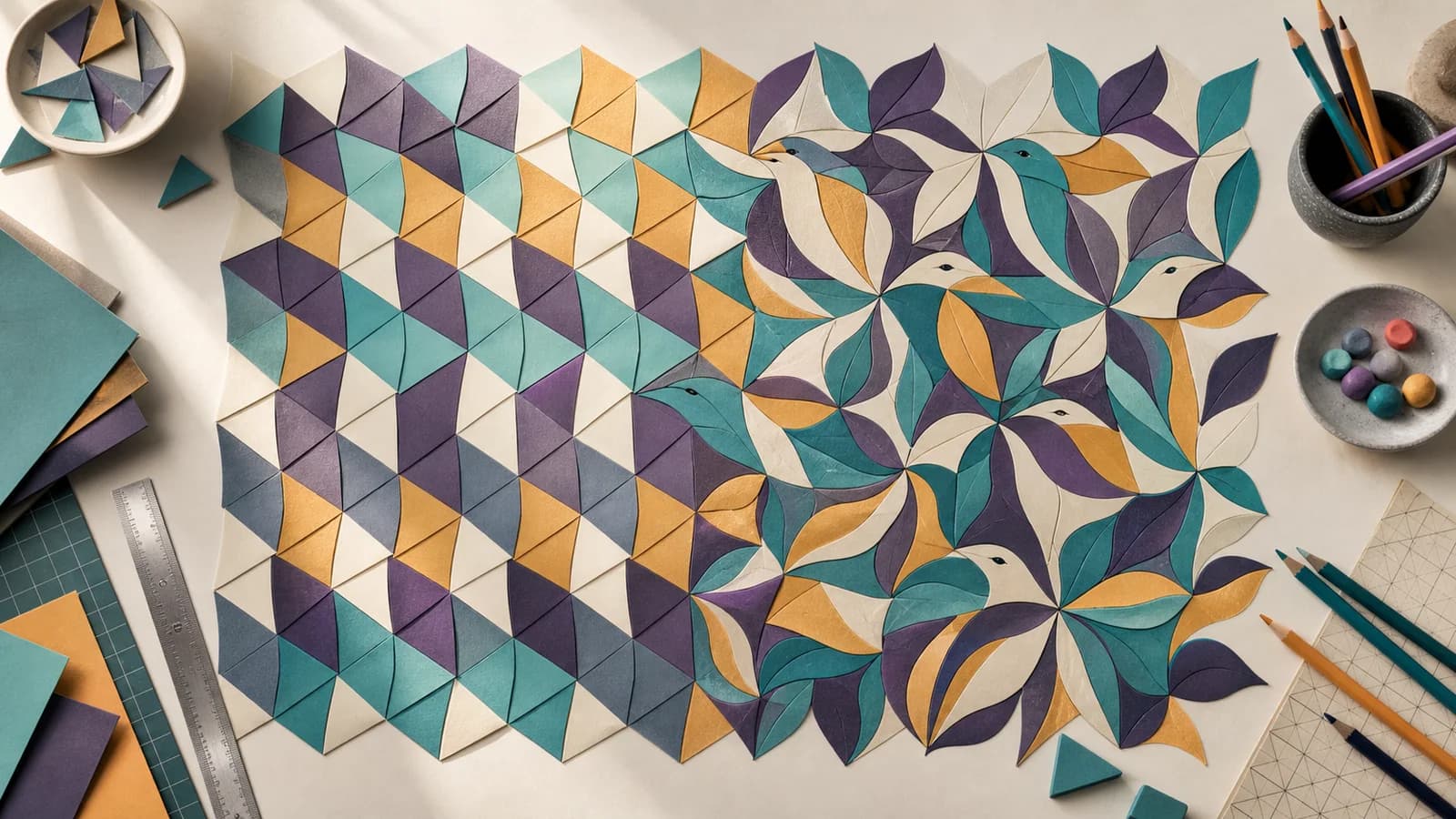
A precise field of interlocking original geometric motifs with one paper tile, pencil and colour tools nearby

This course information is available now. Lesson recordings, captions and the learning area will open after final review.

What you will learn

  • Identify repeating shapes and patterns.
  • Understand the basic meaning of tessellation.
  • Recognise translation, rotation and reflection.
  • Create a repeatable tile.
  • Use colour intentionally.
  • Explain a visual design decision.

Skills developed

Geometry • Symmetry • Pattern • Design • Creativity

Materials

  • Paper or thin card.
  • A pencil and eraser.
  • A ruler.
  • Child-safe scissors.
  • Low-tack tape.
  • Colouring pencils, pens or paints.
  • Optional tracing paper.
  • The course tessellation planning worksheet.
Open printable activity sheet

Future Forge lesson formula

WATCH → TRY → CREATE → CHALLENGE → SHARE

  1. 1

    WATCH

    Discover what a tessellation is; look at tessellations in art, nature and architecture; explore repeating shapes; learn about symmetry and rotation.

  2. 2

    TRY

    Start with a simple repeating shape; move, rotate and repeat it; identify where gaps appear.

  3. 3

    CREATE

    Design an original tessellation, transforming a simple shape into an animal, person, plant, abstract pattern or geometric design.

  4. 4

    CHALLENGE

    Use more than one colour, rotational symmetry, a recognisable image or multiple repeating patterns. Older learners explore the mathematical rules behind the tessellation.

  5. 5

    SHARE

    Display the artwork and explain the shape, symmetry and repetition used.

What the learner creates

An original tessellating artwork.

Parent or guardian note

A parent or guardian can help prepare a square or rectangular card tile and supervise cutting. Encourage the learner to predict whether each change will leave gaps, then test the tile before correcting it for them. Precision can take time, so tracing fewer accurate repeats is more valuable than rushing to fill a large page. Learners who find cutting difficult can ask an adult to cut along their marked line or use the no-cut geometric option described in the lesson.

Safety and access

Use child-safe scissors on a clear, stable table and ask an adult for support where appropriate. Cut away from hands, keep fingers clear of the blades and carry scissors closed. Protect the work surface if pens or paint are used, and allow wet work to dry before moving it.

This free course is self-paced

Work independently through a short, structured introduction and complete one practical outcome at home.

Live guided learning goes further

Paid live lessons add personalised guidance, discussion and access to the wider project library. This free course does not make the full catalogue free.

Explore learning-hour packs